Cal/OSHA scaffold rules are part of California's Construction Safety Orders in Title 8 of the California Code of Regulations, mainly Sections 1637 (general requirements), 1644 (metal scaffolds) and 1646 (tower and rolling scaffolds). They bind employers, so they apply once anyone works on your scaffold for hire. A homeowner working alone is generally outside them, but the same numbers are the safest baseline for any job.
General information only, not legal or engineering advice. Rules change: check the linked primary sources or ask Cal/OSHA before you rely on them.
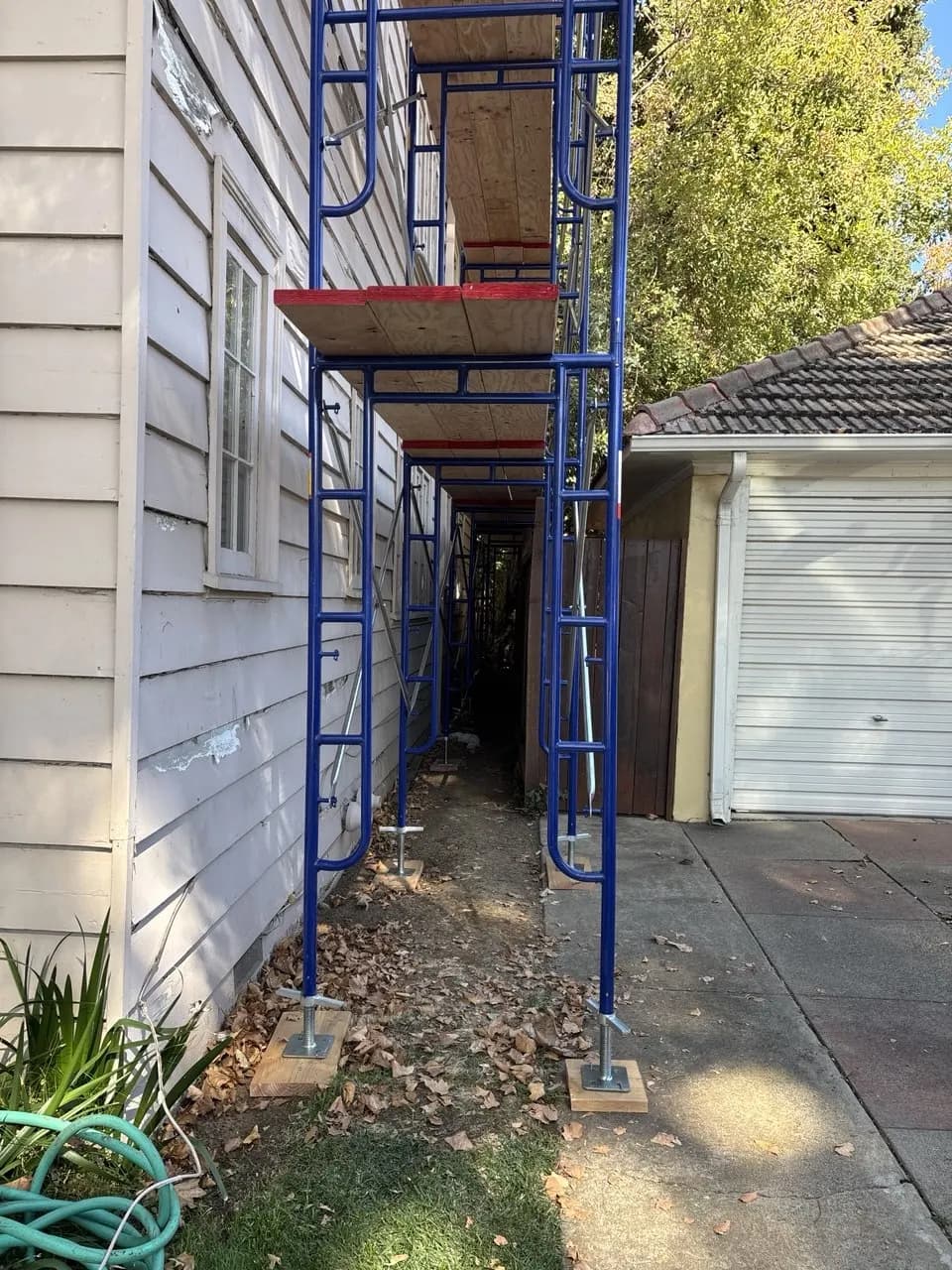
Do Cal/OSHA scaffold rules apply to you?
They apply when someone works for hire. California runs its own workplace safety program: federal OSHA's California State Plan page says the plan covers all private-sector places of employment in the state, administered by Cal/OSHA. Under California Labor Code Section 6303, "employment" includes construction work in which any person is engaged or permitted to work for hire.
In practice:
- You, alone, on your own house: you are not anyone's employer, so the Construction Safety Orders are generally not written for you. Use them anyway. The numbers come from scaffold accidents.
- You pay someone to work on the scaffold: the rules start to matter. If that person works for a contractor, the contractor is the employer. If you hire workers directly, you may be the employer. Since July 1, 2025, Section 6303 also covers household domestic service, with exceptions for ordinary household tasks like cleaning, cooking and caregiving. Ask Cal/OSHA or a lawyer where your project falls.
- You run a crew: they apply to every job. Title 8, Section 1509 also requires every employer to keep an Injury and Illness Prevention Program.
California's rules are often stricter than the federal ones in 29 CFR 1926 Subpart L. Where both mention a number, this guide gives the California one.
The numbers that matter on a small job
Most scaffold rules boil down to a few numbers. To work out how tall your scaffold needs to be in the first place, see what height scaffold do I need. These come from Title 8 Sections 1637, 1644 and 1646.
| Rule | California (Title 8) | Federal (29 CFR 1926) |
|---|---|---|
| Strength | Own weight plus 4 times the maximum intended load (Section 1637) | At least 4 times the maximum intended load (1926.451(a)(1)) |
| Guardrails | Required on platforms 7 1/2 ft or more above grade (Sections 1644 and 1646) | Fall protection above 10 ft (1926.451(g)(1)) |
| Top rail height | 42 to 45 in on metal scaffolds (Section 1644) | 38 to 45 in (1926.451(g)(4)(ii)) |
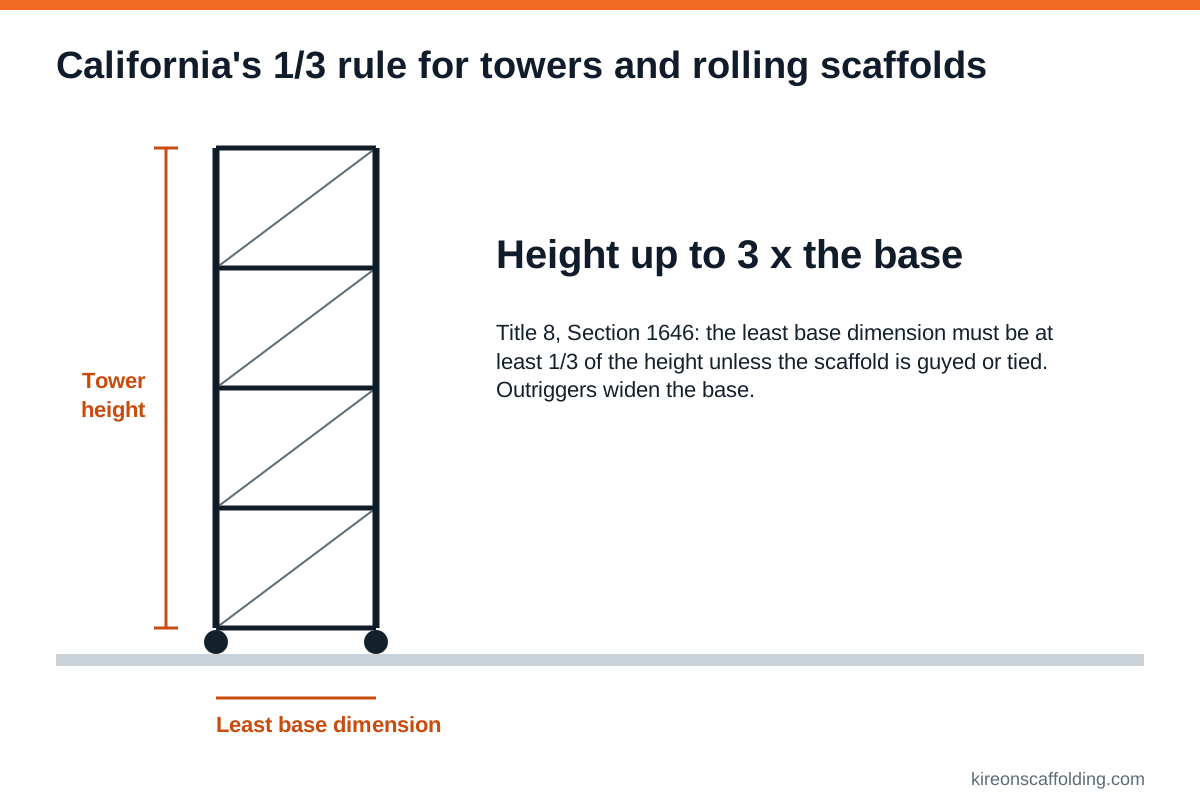
| Tower or rolling scaffold base | Least base dimension at least 1/3 of the height unless guyed or tied (Section 1646) | Restrain from tipping above a 4:1 height to base ratio (1926.451(c)(1)) |
| Frame scaffold ties | At the free ends once platform height exceeds 3 times the least base dimension (Section 1644) | Same 4:1 trigger as above |
| Permit | Cal/OSHA permit for scaffolding intended to be more than 36 ft high (Section 341) | None |
Two more rules from Section 1646 catch people on rolling towers. Casters must have an effective locking device and stay locked while anyone climbs or works on the scaffold. And you may not put a ladder or any unstable object on a rolling scaffold to gain height. Platforms must also be fully planked, except for the openings needed to climb through.
Can anyone ride a rolling scaffold while it moves?
Only employees, and only under tight conditions. Section 1646 lets workers ride a rolling scaffold moved by others only when all its conditions are met, including:
- The floor is within 3 degrees of level and free of pits, holes and obstructions.
- The minimum base dimension is at least half the scaffold height.
- Outriggers, if used, are installed on both sides.
- The wheels have rubber or similar resilient tires.
- Workers on the scaffold are told before each move.
- Nobody stands on any part that sticks out beyond the wheels or supports.
The same section has separate conditions for one worker moving the scaffold alone, and it requires training for everyone who rides or moves one. Equipment manuals can be stricter than the law. The MetalTech manual for its Baker-style units says never to move the scaffold with a worker on it. When the manual and the rule differ, follow the stricter one. For a homeowner, that means: climb down, then move.
Who has to build and check the scaffold?
On a job with employees, a qualified person supervises the build. Title 8, Section 1637 requires erection and dismantling of scaffolds under the supervision of a qualified person. Section 1504 defines that as someone the employer designates who has shown, by training, experience or instruction, that they can safely do the work.
Federal rules use the term competent person. 29 CFR 1926.451 requires a competent person to supervise erecting, moving, dismantling or altering a scaffold, and to inspect it for visible defects before each work shift. 29 CFR 1926.454 requires training for everyone who works on a scaffold.
For frame scaffold, Section 1644 makes the manufacturer's erection instructions mandatory on every installation. Get the manual with the rental and keep it on site.
Kireon rents and sells equipment only. It does not erect, inspect or supervise scaffolding, so the renter is responsible for the build and the inspection.
Do you need a permit for scaffolding in California?
For the heights a homeowner or small crew uses, a Cal/OSHA permit usually is not the issue. Title 8, Section 341 requires an employer permit for erecting scaffolding intended to be more than 36 ft high when completed. Rolling towers like the 18 ft tower Kireon rents are far below that.
Local rules are a separate question. If the scaffold will stand on a public sidewalk or street, ask your city or county before you set it up. For Sacramento, the Sacramento scaffold rental page lists the city contacts and forms.
A pre-use checklist based on the rules
Run through this every day before anyone climbs:
- The ground is firm. Rolling towers stand on a flat, level, hard surface only.
- Base plates or locked casters are on every leg, and on soil each plate sits on a solid wooden base.
- The base is wide enough: at least 1/3 of the height for a tower, with outriggers installed on both sides when the tower uses them.
- All braces are in place and their locks are engaged.
- Platforms are fully planked and latched.
- Guardrails are on every open side of any platform 7 1/2 ft or higher.
- Every caster is locked before anyone climbs.
- No power lines nearby. Metal scaffold conducts electricity.
- The weather is calm. Do not work on a scaffold in high wind.
- Nothing is stacked on the platform to gain height.
Two related guides help with the equipment side: rolling tower vs frame scaffold and 18 ft rolling tower specs. When you know what you need, send a quote request with the job address, dates and wall height.
Frequently asked questions
Do OSHA scaffold rules apply to homeowners in California?
Cal/OSHA rules bind employers. A homeowner working alone on their own house is generally not an employer, so the rules are not written for that case. Once you pay someone to work, they can apply. Ask Cal/OSHA if you are unsure.
At what height does a scaffold need guardrails in California?
At 7 1/2 ft. Title 8 Sections 1644 and 1646 require railings on open sides and ends of platforms 7 1/2 ft or more above grade. Federal OSHA sets fall protection at more than 10 ft.
Do I need a permit to put up scaffolding in California?
A Cal/OSHA permit is required for scaffolding intended to be more than 36 ft high (Title 8 Section 341), and it is an employer permit. For a scaffold on a public sidewalk or street, ask your city or county about local permits.
How tall can a rolling scaffold be in California?
There is no single height limit, but Title 8 Section 1646 says the minimum base dimension must be at least 1/3 of the height unless the scaffold is guyed or tied. Taller towers need a wider base, usually from outriggers.
Who can set up a scaffold under Cal/OSHA rules?
On a job with employees, erection and dismantling must be supervised by a qualified person (Title 8 Section 1637): someone the employer designates who has shown, by training, experience or instruction, that they can do it safely.
Is this legal advice?
No. This guide is general information based on the linked regulations as of the date above. Rules and their interpretation change, so check the current text or ask Cal/OSHA or a lawyer about your specific job.
Sources
- Cal/OSHA Title 8, Section 1637: Scaffolds, General Requirements
- Cal/OSHA Title 8, Section 1644: Metal Scaffolds
- Cal/OSHA Title 8, Section 1646: Tower Scaffolds and Rolling Scaffolds, Wood or Metal
- Cal/OSHA Title 8, Section 1504: Definitions (qualified person)
- Cal/OSHA Title 8, Section 1509: Injury and Illness Prevention Program
- Cal/OSHA Title 8, Section 341: Permit Requirements
- California Labor Code Section 6303: definitions of place of employment and employment
- OSHA: California State Plan
- OSHA 29 CFR 1926 Subpart L: Scaffolds
- OSHA 29 CFR 1926.451: Scaffolds, General Requirements
- OSHA 29 CFR 1926.454: Training Requirements
- MetalTech Jobsite Series 6 ft Baker (I-CISC): Operational Safety and Assembly Instructions (PDF)
Next step: see rolling tower rental or frame scaffold rental, then request a quote with your dates and ZIP code.
Kireon provides scaffold equipment rental and sales only. Kireon does not erect, assemble, dismantle, engineer, design, inspect or supervise scaffolding and does not provide competent-person or jobsite safety-management services.