A rolling scaffold tower is a single freestanding scaffold bay on locking casters that you roll from spot to spot on a firm, flat floor. A frame scaffold is a run of welded frames, cross braces and planks set on base plates along a wall. Rent a tower for work you reach one spot at a time. Rent frame scaffold for a long wall or for ground that is not flat.
The short answer: four questions decide it
Pick by ground, wall length and how often you move, not by height alone. If the floor is hard and flat and you work one spot at a time, rent a rolling tower. If the ground is soft or sloped, or the wall is long and you want to walk along it, rent frame scaffold.
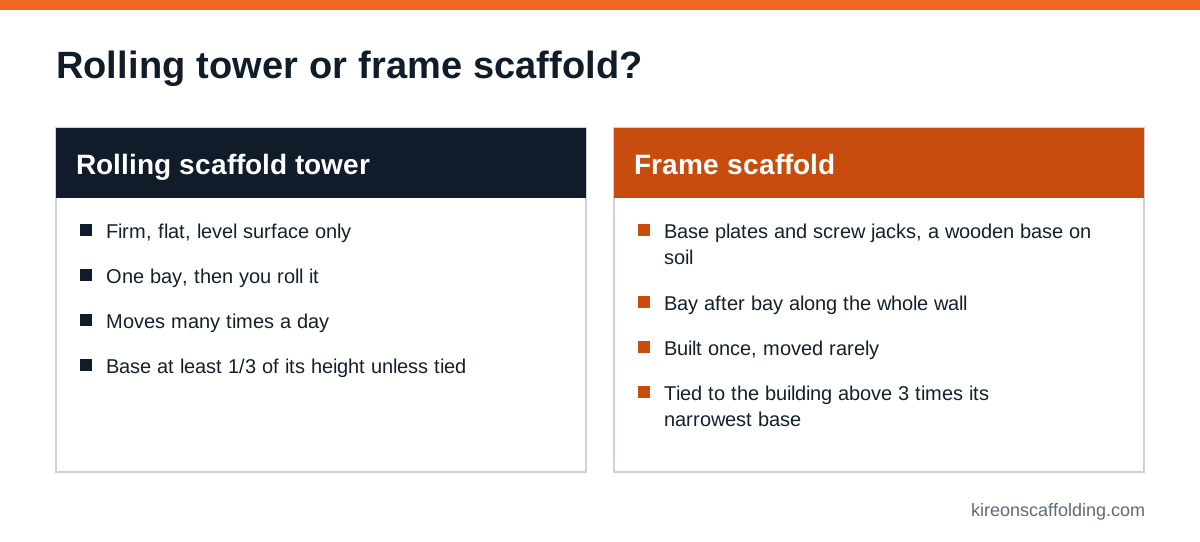
| Question | Rolling scaffold tower | Frame scaffold |
|---|---|---|
| What is under it? | Firm, flat, level surface only: concrete slab, driveway, garage or shop floor | Base plates on firm ground, a wooden base on soil, screw jacks to level |
| How much wall per setup? | One bay, then you roll it | Bay after bay along the whole wall |
| How often do you move? | Many times a day | Rarely, moving means taking bays apart |
| How tall can it stand freely? | Base at least 1/3 of the height in California unless tied, so tall towers need outriggers | Tied to the building once it gets taller than 3 times its narrowest base |
| Who builds it? | You, following the manufacturer's instructions | You or your crew, following the manufacturer's instructions |
Kireon rents both: an 18 ft and a 15 ft rolling tower and frame scaffold by quote.
What is a rolling scaffold tower?
A rolling scaffold tower is one scaffold bay built on casters, with a platform, guardrails and usually outriggers, that you push to the next spot instead of rebuilding. It is the scaffold version of a very stable, very tall stepladder.
Kireon has two. The 18 ft rolling tower is a MetalTech Baker-style tower made of stacked Baker frames with outriggers and a top guardrail. The 15 ft rolling tower is built from frame-scaffold components on casters.
Towers fit work you reach one area at a time:
- Ceilings, drywall and paint in rooms with high ceilings
- Light fixtures, ducts and sprinkler lines in garages and shops
- Eaves, soffits and gutters above a flat concrete driveway or patio
- Short exterior repairs on a single-story wall
Whatever the job, lock every caster before anyone climbs. Cal/OSHA Title 8, Section 1646 requires casters to stay locked while workers climb or work on a rolling scaffold.
What is frame scaffold?
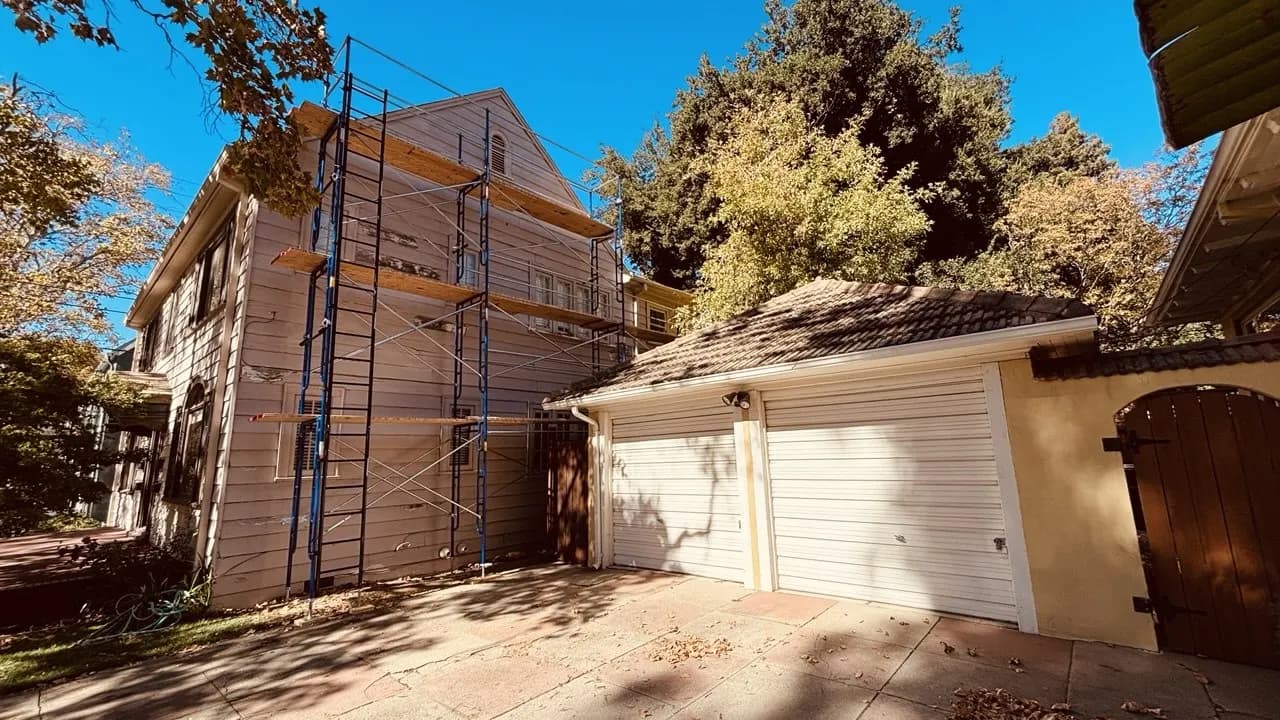
Frame scaffold is a system of welded steel frames joined by cross braces, with planks or platforms on top, set on base plates or screw jacks and built along a wall one bay at a time. You build it once and work from it for days or weeks.
The 15 ft tower Kireon sells uses this kind of hardware: 5 x 5 ft ladder frames, 7 ft cross braces and 7 ft platforms. A frame scaffold rental is the same idea at the size of your wall, so Kireon quotes it from your wall length and height.
Frame scaffold fits:
- Stucco, siding and exterior paint on long walls
- Two-story walls where you need a working level along the whole side
- Masonry and other work where material sits on the platform
- Side yards with dirt, lawn or a gentle slope
Taller frame scaffold has to be tied to the building. Title 8, Section 1644 requires ties at the free ends once the platform height exceeds 3 times the least base dimension, plus more ties as it gets taller.
Is your ground flat enough for a rolling tower?
A rolling tower needs a firm, flat and level surface. Kireon does not rent its towers for slopes, stairs, uneven ground, soft soil or unstable surfaces, and the MetalTech manual for its Baker units says never to put anything under the scaffold to make up for uneven ground.
Walk the work area before you call. In Sacramento-area yards the usual problems are lawn, gravel, a sloped side yard, planters and a step between the patio and the driveway. Any of those points to frame scaffold.
Frame scaffold handles that ground because each leg stands on its own base. Section 1644 says scaffold legs rest on base plates, and on earth or soft material each plate sits on the equivalent of a 2 x 10 x 10 in wooden base. Screw jacks take up the difference in height so the frames stand plumb and level.
How high can each one go safely?
Height is limited by the base. California's rule for towers is stricter than the federal one, so plan for it.
- Rolling towers: Section 1646 says the minimum base dimension must be at least 1/3 of the scaffold height unless the tower is guyed or tied. Federal OSHA, in 29 CFR 1926.451, allows up to 4:1 before restraint is required. Outriggers widen the base, which is why the 18 ft tower comes with them.
- Frame scaffold: it grows by stacking frames and stays stable by tying into the building, as described above.
- Guardrails: Section 1646 requires railings once the platform is 7 1/2 ft or more above grade. Federal OSHA starts fall protection at 10 ft, so California asks for rails earlier.
The Cal/OSHA scaffold rules guide covers these numbers and who they apply to.
How often will you move it?
If you move more than a couple of times a day, a tower saves hours. Unlock the casters, clear the platform, roll it, lock it again. Federal rule 29 CFR 1926.452(w) says to push a rolling scaffold as close to the base as practicable. MetalTech's manual goes further: never move the scaffold with a worker on it.
Frame scaffold does not roll. Moving it means taking bays apart and rebuilding them, so it pays off when the work stays in one place long enough, like a full stucco wall.
Who assembles a rented scaffold?
You do, or your crew. Kireon rents and sells the equipment only and does not erect, assemble, dismantle, inspect or supervise scaffolding. Both types go up according to the manufacturer's instructions, which Section 1644 makes mandatory for frame scaffold.
On a job with employees, Title 8, Section 1637 requires scaffold erection and dismantling under the supervision of a qualified person. If nobody on your crew has built scaffold before, plan the extra time or hire a licensed contractor who does this work.
Quick picks for common jobs
- Repainting a living room with a high ceiling: rolling tower.
- Gutters and fascia above a flat concrete driveway: rolling tower.
- Stucco repair along a 40 ft two-story wall: frame scaffold.
- Siding on a sloped side yard with lawn: frame scaffold.
- Garage or shop lighting on a slab floor: rolling tower.
Not sure? Send photos of the wall and the ground with a quote request, and Kireon will confirm which equipment is available for it. The 18 ft tower specs guide covers what that tower carries and reaches.
Frequently asked questions
Can I put a rolling scaffold tower on grass or gravel?
No. A rolling tower is for firm, flat and level surfaces only. Grass, gravel, soft soil, slopes and stairs let a caster sink or roll. On that kind of ground, use frame scaffold on base plates with a wooden base under each plate.
Is a rolling tower or frame scaffold better for exterior painting?
For a single-story house on a flat driveway or patio, a rolling tower is quicker because you roll it along the wall. For a two-story wall, a long run of stucco or siding, or a sloped side yard, frame scaffold is the better fit.
How high can a rolling scaffold tower go without tying it off?
In California, Title 8 Section 1646 says the minimum base dimension of a tower or rolling scaffold must be at least 1/3 of its height unless it is guyed or tied. Outriggers widen the base so a taller tower can meet that ratio.
Does frame scaffold have to be tied to the house?
Often, yes. Title 8 Section 1644 requires ties at the free ends once the platform height exceeds 3 times the least base dimension, plus more ties as the scaffold gets taller. Follow the manufacturer's instructions for tie spacing.
Does Kireon set up the scaffold?
No. Kireon rents and sells scaffold equipment only. The renter or the renter's qualified crew assembles, inspects and uses it according to the manufacturer's instructions and the rules that apply to the job.
Sources
- Cal/OSHA Title 8, Section 1646: Tower Scaffolds and Rolling Scaffolds, Wood or Metal
- Cal/OSHA Title 8, Section 1644: Metal Scaffolds
- Cal/OSHA Title 8, Section 1637: Scaffolds, General Requirements
- OSHA 29 CFR 1926.451: Scaffolds, General Requirements
- OSHA 29 CFR 1926.452: Additional Requirements for Specific Types of Scaffolds
- MetalTech Jobsite Series 6 ft Baker (I-CISC): Operational Safety and Assembly Instructions (PDF)
Next step: see rolling tower rental or frame scaffold rental, then request a quote with your dates and ZIP code.
Kireon provides scaffold equipment rental and sales only. Kireon does not erect, assemble, dismantle, engineer, design, inspect or supervise scaffolding and does not provide competent-person or jobsite safety-management services.