A rolling scaffold inspection checklist is a short list of parts and conditions you check before anyone climbs: frames, braces and their locks, casters and caster locks, the platform deck, guardrails, toeboards, the ground and anything overhead. Run it three times: when you pick up the rental, every day before work, and right before you climb. Cal/OSHA Title 8 and federal OSHA rules back each item.
General information only, not legal or engineering advice. Rules change: check the linked primary sources or ask Cal/OSHA before you rely on them.
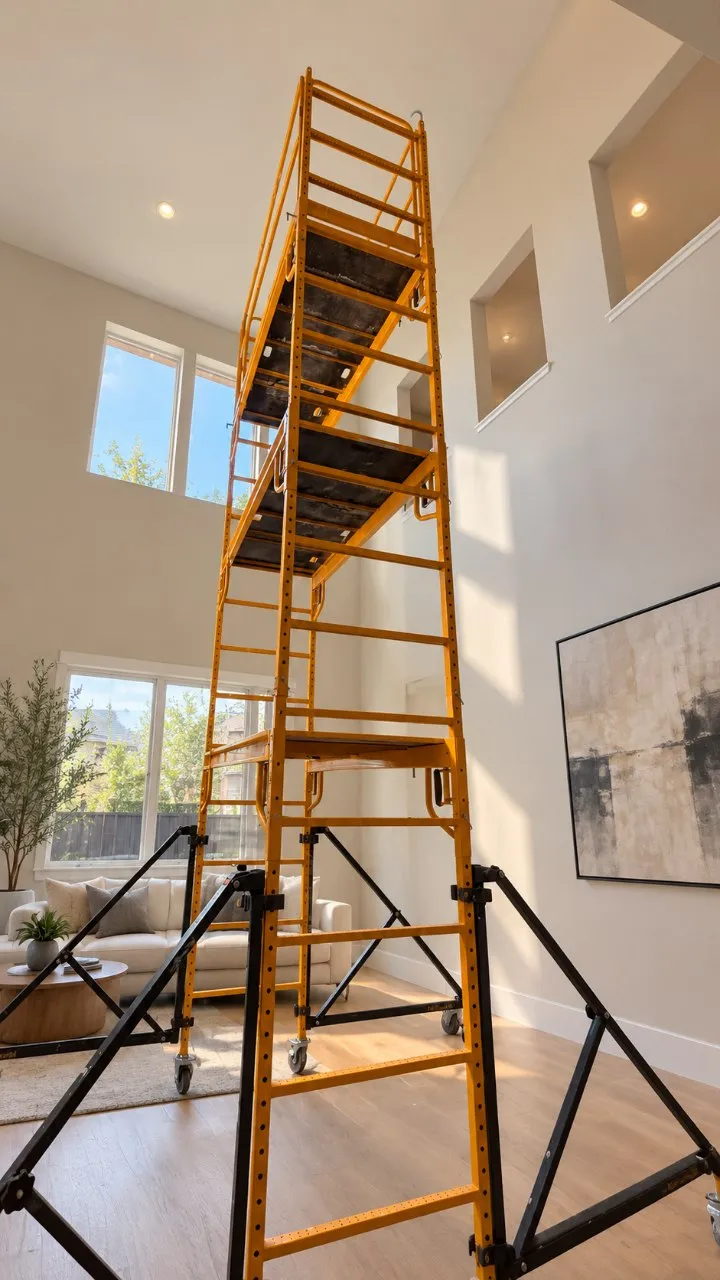
Who inspects a rented rolling scaffold?
You do. The person or crew using the scaffold checks it, not the rental company. Kireon rents and sells equipment only and does not inspect scaffolding for you. The rental terms list inspection among the renter's jobs, next to following the manufacturer's instructions.
The rules point the same way. Federal 29 CFR 1926.451 requires a competent person to inspect scaffolds and their parts for visible defects before each work shift and after anything that could affect the scaffold's structure. In California, Title 8, Section 1637 requires every scaffold plank to be visually inspected for defects before use each day. These rules bind employers, but they make a good routine for a homeowner too.
The MetalTech manual for its Baker-style units says it in two lines: inspect before use, and do not use the scaffold if it is damaged or parts are missing.
This checklist is general information, not legal advice. It covers three moments: when you take the equipment, every morning, and right before anyone climbs. For the full rule set, see the Cal/OSHA scaffold rules guide.
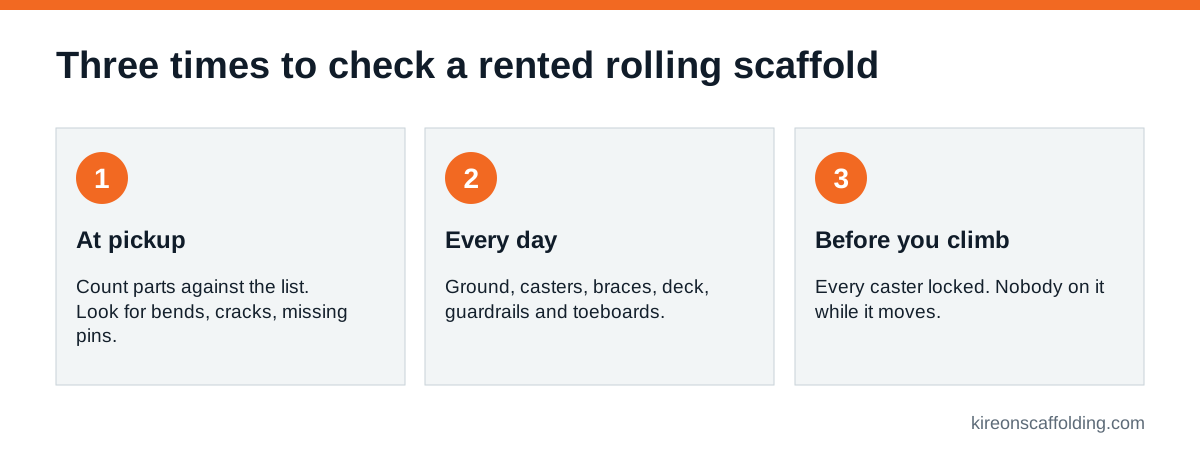
Checklist 1: at pickup or delivery
Check the parts before the equipment leaves the yard, or before the driver leaves your site. A missing pin is easy to sort out at pickup and a real problem halfway up a wall.
- Count the parts against the equipment list on your quote: frames, braces, platform, casters and locking pins, plus guardrails and outriggers if you ordered them.
- Frames: no bends, cracks or crushed tubes. MetalTech says never to try to straighten a deformed side rail or decking member.
- Braces: the locking mechanisms snap in and hold. MetalTech says not to use any brace with a damaged locking device.
- Casters: each wheel turns, and the lock holds it when you press the tab. The locking pins that fix the casters to the frames are all there.
- Platform deck: no loose or missing steel parts, no large holes or thin, worn spots in the plywood, and the security latches work.
- Guardrails and outriggers: the pieces match the height you plan to build.
If something is missing or damaged, point it out before you take the equipment and have it noted on the pickup or delivery paperwork. The rental terms say missing or damaged equipment may be charged under the signed agreement, so record the condition at the start.
Checklist 2: every day before work
Run this list each morning after the scaffold is standing and before anyone goes up. It takes a few minutes. Each line names the rule or manual it comes from, so you can read the original.
| Check | What to look for | Source |
|---|---|---|
| Ground | Firm and level, no pits, holes or debris under any wheel | MetalTech manual |
| Base width | Least base dimension at least 1/3 of the height unless guyed or tied, outriggers when units are stacked | Title 8, Section 1646(a), MetalTech |
| Casters | All locked, all pinned to the frames | Section 1646(c), MetalTech |
| Joints | Locked with lock pins, bolts or equal fasteners, caster joints included | Section 1646(d) |
| Braces | At least two side braces on each level, every lock engaged | MetalTech |
| Leveling jacks | At least 1/3 of the screw jack inside the leg, exposed thread 12 in or less | Section 1646(b)(2) |
| Platform | Tightly planked for the full width except the access opening, deck seated and latched | Section 1646(e), MetalTech |
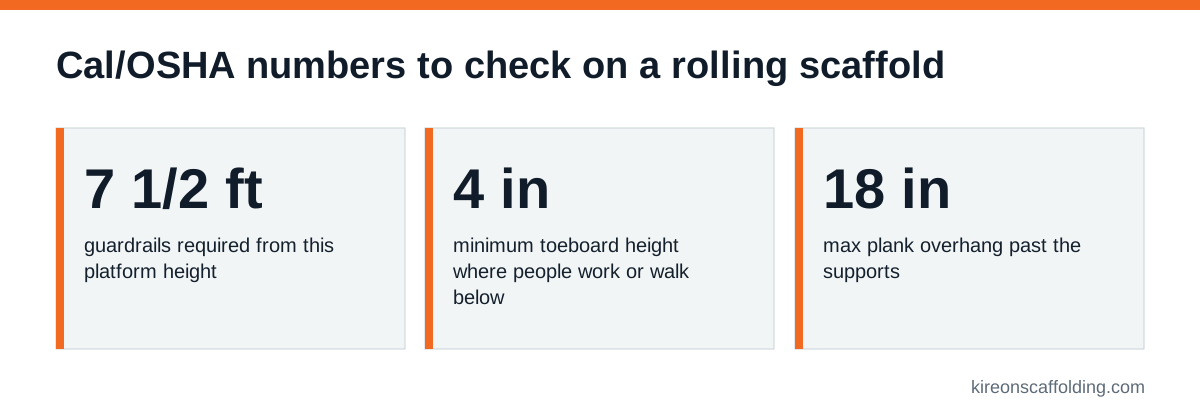
| Planks | No more than 18 in past the supports, no cracks or damage | Sections 1646(e) and 1637(f) |
| Guardrails | On open sides and ends at 7 1/2 ft and up, top rail 42 to 45 in, midrail about halfway | Sections 1646(b)(1) and 1644(a)(6) |
| Toeboards | At least 4 in high where people work or walk under the scaffold | Section 1621(b) |
| Overhead | No power lines or live circuits within reach, metal conducts electricity | MetalTech |
| Weather and deck | No rain or high wind, no oil, grease or debris on the deck or climbing surfaces | MetalTech |
The California sections are 1646 for rolling towers, 1644 for metal scaffolds and 1621 for railings and toeboards.
Two details deserve a second look. First, the manual can be stricter than the law. MetalTech wants guardrails on all open sides where a person could fall 6 ft or more, which is lower than the 7 1/2 ft Cal/OSHA line. Follow the stricter number. Second, test the casters by hand: press each lock, then push on the frame and make sure no wheel turns.
For frame sizes and load ratings of the taller unit, see the 18 ft rolling tower specs.
Checklist 3: right before you climb
The last check happens at the base of the tower, every time you go up, including after each move.
- Every caster locked. Section 1646(c) requires casters to stay locked while workers climb or work on the scaffold.
- Nobody on the platform while it moves. MetalTech says never to move the scaffold with a worker on it.
- Tools fastened or removed before a move. After the move, check the tower for level and lock the casters again.
- Climb the side frames facing the ladder, with three points of contact and your body close to the frame.
- Nothing on the deck to gain height. Section 1646(f) bans ladders or other unstable objects on top of a rolling scaffold. MetalTech also says never to place anything under it to gain height.
- Body centered inside the frame. Do not lean over the guardrail to reach.
When should you stop using the scaffold?
Stop as soon as a check fails. Title 8, Section 1644 says metal scaffold equipment that is broken or deteriorated enough to weaken it must not be used. Section 1637 says defective or damaged planks must be removed from service. Federal rule 1926.451(f)(4) says a damaged or weakened part must be repaired, replaced or removed from service right away.
Typical reasons to stop:
- a bent or cracked frame, brace or side rail
- a brace lock or caster lock that does not hold
- a missing pin, guardrail piece or deck latch
- a hole, soft spot or worn-through area in the deck
- an impact or event that could have affected the structure (1926.451(f)(3) calls for a new inspection after one)
- parts exposed to fire or high heat, which MetalTech says to remove from service
Do not repair or modify rental parts yourself. MetalTech says not to modify the scaffold or any of its parts. Take it out of use, keep people off it and call or text Kireon.
Get a tower that fits the job
A checklist works best on equipment sized for the work. Compare the 15 ft and 18 ft units on the rolling tower rental page or go straight to the 18 ft rolling tower rental. When you know what you need, request a quote with the job address, dates and wall height.
Frequently asked questions
How often should a rolling scaffold be inspected?
Before each work shift and after anything that could affect its structure, per federal 29 CFR 1926.451(f)(3). Cal/OSHA Title 8, Section 1637 also requires a visual check of every plank before use each day. Add a quick check every time you move the tower.
Who is responsible for inspecting a rented scaffold?
The renter. Kireon provides equipment only and does not erect, inspect or supervise scaffolding. On a job with employees, the employer's competent or qualified person does the inspection before each shift.
At what height does a rolling scaffold need guardrails in California?
At 7 1/2 ft above grade, per Title 8, Section 1646. Section 1644 puts the top rail at 42 to 45 in with a midrail about halfway. The MetalTech manual asks for guardrails at a 6 ft fall, so follow the stricter number.
Do rolling scaffolds need toeboards?
Where people work or walk under the scaffold, yes. Title 8, Section 1621 requires toeboards at least 4 in high on the open sides and ends of railed scaffolds in those spots. Section 1646 also notes that toeboards may be required.
Are scaffold inspection tags required?
Not by the rules cited in this guide. Neither 29 CFR 1926.451 nor Title 8 Sections 1621, 1637, 1644 and 1646 mention an inspection tag. They require the inspection itself and removal of damaged parts. On a job site that uses tags, follow the site rules.
What should I do if a part is missing at pickup?
Point it out before you take the equipment and have it noted on the pickup or delivery paperwork. Do not build or climb the scaffold with parts missing. The MetalTech manual says not to use it if it is damaged or parts are missing.
Sources
- Cal/OSHA Title 8, Section 1646: Tower Scaffolds and Rolling Scaffolds, Wood or Metal
- Cal/OSHA Title 8, Section 1644: Metal Scaffolds
- Cal/OSHA Title 8, Section 1637: Scaffolds, General Requirements
- Cal/OSHA Title 8, Section 1621: Railings and Toeboards on Scaffolds
- OSHA 29 CFR 1926.451: Scaffolds, General Requirements
- MetalTech Jobsite Series 6 ft Baker (I-CISC): Operational Safety and Assembly Instructions (PDF)
Next step: see rolling tower rental or 18 ft rolling tower rental, then request a quote with your dates and ZIP code.
Kireon provides scaffold equipment rental and sales only. Kireon does not erect, assemble, dismantle, engineer, design, inspect or supervise scaffolding and does not provide competent-person or jobsite safety-management services.